
What to See Inside the Royal Palace of Madrid
Quick Answer: If you are visiting the Royal Palace of Madrid for the first time, don't miss the Main Staircase, Throne Room, Gasparini Room, Hall of Columns and Royal Armoury. These highlights reveal the palace's architecture, royal ceremonies, decorative arts and centuries of Spanish history.
From Plaza de Oriente, the Royal Palace already looks impressive.
But the real reason to visit is what lies behind its doors.
The palace interiors contain richly decorated ceremonial rooms, historic furnishings, paintings, tapestries, chandeliers, royal collections and spaces still connected to official state ceremonies.
You won't visit all of the palace's thousands of rooms. Instead, the public route takes you through a selection of its most important spaces.
Here are the highlights worth watching for.
1. The Main Staircase
The Main Staircase is one of the first major sights inside the Royal Palace and immediately establishes the scale of the building.
Designed as a ceremonial entrance, the staircase uses marble, monumental proportions and a vast decorated ceiling to create a suitably dramatic arrival.
Don't rush through it simply because it's at the beginning of your visit.
Look upward as well as around you.
The staircase was designed to impress guests arriving at the royal residence, and it still performs that role remarkably well today.
For first-time visitors, this is where the experience of the palace really begins.
2. The Throne Room
If you only remember one room after your visit, there's a good chance it will be the Throne Room.
It is one of the most important ceremonial spaces in the Royal Palace of Madrid and retains the extravagant decoration associated with the reign of Charles III.
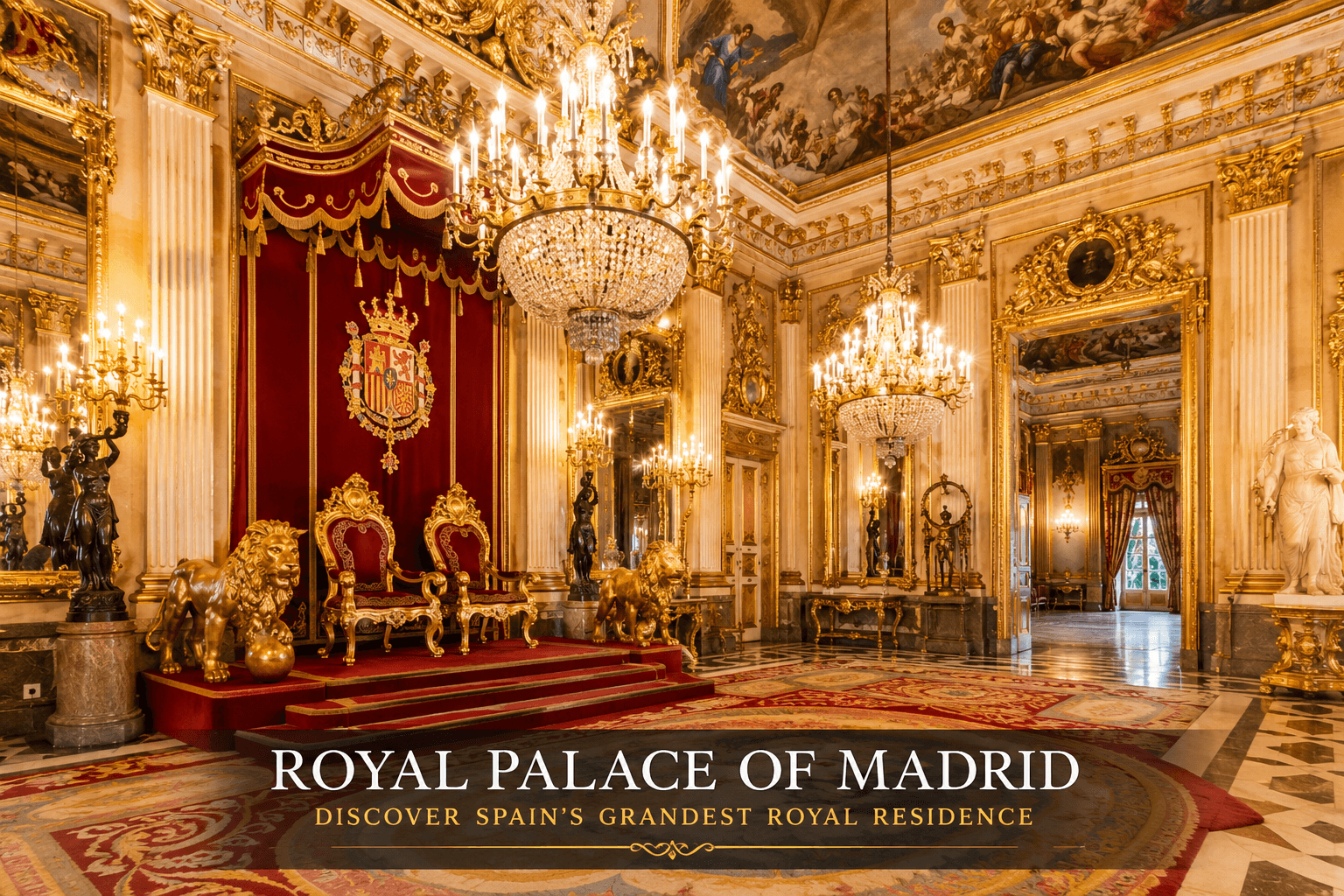
The room combines deep red velvet, gilded decoration, mirrors, chandeliers and the royal thrones.
Two gilded bronze lions stand beside the throne area, reinforcing the ceremonial character of the room.
But one of the most impressive details is above you.
The ceiling was decorated by the Venetian painter Giovanni Battista Tiepolo, whose monumental fresco adds another layer of drama to the room.
The Throne Room is a good example of why visiting the palace with historical context can make such a difference.
Without explanation, it is spectacular.
Once you understand how these ceremonial spaces were designed to communicate royal authority, the details become much more meaningful.
Read our Royal Palace Madrid guided tour vs self-guided guide to decide how you would prefer to experience the palace interiors.
3. The Gasparini Room
The Gasparini Room is completely different from the Throne Room but equally memorable.
It represents the elaborate Rococo taste associated with Charles III's palace.
What makes the room particularly interesting is how completely its decoration works together.
Walls, ceiling, fabrics, furniture and floor form part of the same visual design.
Instead of focusing on one painting or object, look at the room as a whole.
The intricate patterns and decorative details make it one of the palace's most distinctive interiors.
For visitors interested in interior design, craftsmanship or decorative arts, this may end up being one of the highlights of the entire visit.
4. The Hall of Columns
The Hall of Columns is another important ceremonial space.
Its scale makes it impressive immediately, but its significance goes beyond architecture.
The hall has been associated with important royal and state occasions throughout Spanish history and continues to form part of the palace's ceremonial identity.
This is one of those rooms where historical explanation adds considerable value.
A visitor walking independently may appreciate its size and decoration.
A visitor who understands the events connected to the space gets a much clearer sense of why the room matters.
5. The State Dining Room
The State Dining Room shows another side of palace life: formal royal entertaining.
It is an enormous ceremonial dining space designed for official banquets.
The long dining table, chandeliers, ceiling decoration, tapestries and elaborate furnishings make it one of the easiest rooms in which to imagine the palace actually functioning rather than simply existing as a historic attraction.
Unlike rooms that feel frozen in the distant past, the dining room helps remind visitors that the Royal Palace remains associated with official state occasions.
Take a moment to look beyond the table itself.
The ceiling and surrounding decoration are an important part of the room's overall effect.
6. The Royal Chapel
The Royal Chapel brings a different atmosphere to the visit.
After the grandeur of ceremonial rooms such as the Throne Room and State Dining Room, the chapel introduces the religious and musical traditions of the Spanish court.
Its interior combines marble, gilded details and painted decoration.
The palace is also associated with an exceptional collection of historic string instruments, including the famous Palatine Stradivarius collection.
Access to particular palace spaces can vary, especially when official events or operational requirements affect the visitor route, so not every visit will necessarily be identical.
7. The Royal Armoury
Don't finish your palace visit without considering the Royal Armoury.
It's easy to focus entirely on the State Rooms, but the armoury is one of the palace's most significant collections.
It contains historic armour and weapons connected with the Spanish monarchy, including pieces associated with rulers such as Charles V and Philip II.
Some of the most striking exhibits include elaborate suits of armour created not only for battle but also for tournaments, ceremonies and displays of royal power.
There is even armour designed for horses.
The level of craftsmanship is remarkable.
Look closely and you'll see intricate engraving, decoration and metalwork that transforms functional armour into works of art.
For families, history enthusiasts and visitors interested in medieval and Renaissance Europe, the Royal Armoury can be one of the most enjoyable parts of the visit.
What Should You Prioritize If You Have Limited Time?
If your Madrid itinerary is tight, don't try to study every object in every room.
Concentrate on the major highlights.
We would prioritize:
Main Staircase
Throne Room
Gasparini Room
Hall of Columns
State Dining Room
Royal Armoury
That gives you a good balance of architecture, royal ceremony, decorative art and Spanish history.
If you have more time, slow down through the State Rooms and explore the additional collections and spaces available during your visit.
Read our guide to how long you need at the Royal Palace of Madrid to plan enough time for the palace interiors and main highlights.
Can You See Every Room in the Royal Palace?
No.
The Royal Palace of Madrid contains thousands of rooms, but only a selection forms part of the visitor experience.
Some areas remain unavailable to ordinary visitors, while access to particular spaces can also change.
This is important because the Royal Palace isn't simply a former royal residence preserved as a museum.
It remains an official royal palace used for state ceremonies and formal events.
That means certain rooms or parts of the visitor route can occasionally close for official use.
Don't plan your visit around seeing one specific room without allowing for possible changes.
Is the Royal Palace Still Used by the Spanish Royal Family?
The Royal Palace remains the official residence of the Spanish Crown, but the Spanish royal family does not normally live there.
Instead, the palace continues to be used for important ceremonies, state occasions and official events.
That living ceremonial role is part of what makes visiting particularly interesting.
You're not simply walking through a building whose royal purpose ended centuries ago.
Many of the spaces still have an official function.
Can You Take Photos Inside the Royal Palace?
Photography rules can vary between areas of the Royal Palace.
Don't assume that photography is permitted everywhere simply because you can take photographs in one section.
Follow the signs and instructions from palace staff during your visit.
Even when photography is restricted, it's worth slowing down and actually looking at the rooms rather than experiencing the entire palace through a phone screen.
There is an enormous amount of detail above eye level, particularly in ceilings, chandeliers and decorative finishes.
Should You Visit the Royal Armoury?
Yes, especially if this is your first visit.
The Royal Armoury is sometimes overshadowed by the palace's State Rooms when people plan their visit.
That is a mistake.
The collection gives you a very different perspective on the Spanish monarchy and the way royal power was represented through warfare, tournaments and ceremony.
If you're visiting with children or teenagers who aren't particularly interested in decorative interiors, the armoury may also hold their attention more easily than some of the State Rooms.
Allow some additional time rather than rushing straight out after the main palace route.
What About the Royal Collections Gallery?
The Gallery of the Royal Collections is located beside the Royal Palace and displays works and objects collected by the Spanish monarchy over centuries.
It opened to the public in 2023 and provides a much deeper look at the artistic collections associated with the Crown.
However, don't confuse it with the main Royal Palace interior.
If your primary goal is visiting the Royal Palace, concentrate first on the palace State Rooms and collections included in your chosen experience.
Visitors particularly interested in Spanish royal art and collecting can then consider adding the gallery separately depending on their ticket and available time.
Is It Better to Visit With a Guide?
That depends on what you want from the experience.
If your priority is simply seeing the palace's impressive interiors, independent entry can work perfectly well.
If you want to understand why the Throne Room looks the way it does, how the palace was used, who lived in its rooms and what important events happened there, a guided tour provides much more context.
This is particularly useful in rooms such as the Hall of Columns and Throne Room, where historical significance isn't always obvious from appearance alone.
For first-time visitors interested in Spanish history, we generally think the additional explanation makes the palace more memorable.
Is the Royal Palace of Madrid Worth Seeing Inside?
Yes.
Seeing only the exterior doesn't give you the full experience.
The façade communicates the scale of the Royal Palace, but its State Rooms reveal how Spain's monarchy expressed power, ceremony, art and royal life through architecture and decoration.
The contrast between different interiors is also part of the experience.
The Throne Room feels ceremonial and imposing.
The Gasparini Room is intricate and decorative.
The State Dining Room demonstrates royal entertaining.
The Royal Armoury reveals another side of monarchy entirely.
Together, these spaces make the interior far more interesting than simply seeing the palace from Plaza de Oriente.
Read our complete guide to whether the Royal Palace of Madrid is worth visiting and what makes it one of Madrid's major historic attractions.
Tips for Seeing the Palace Highlights
A little planning makes the visit easier.
Book ahead. The Royal Palace has controlled visitor capacity, and advance booking is recommended if you want a particular date or time.
Look up. Some of the palace's finest artwork and decoration is on the ceilings.
Don't rush the first rooms. The Main Staircase isn't simply a passageway to the rest of the palace.
Save time for the Royal Armoury. Don't accidentally leave it until you're too tired to enjoy it.
Consider a guide if history matters to you. Many rooms become considerably more interesting once you understand their purpose.
Allow for changes. The palace remains an official venue, so the visitor route can sometimes be affected by ceremonies or official events.
Final Answer: What Should You See Inside the Royal Palace of Madrid?
For a first visit, the essential highlights are the Main Staircase, Throne Room, Gasparini Room, Hall of Columns, State Dining Room, Royal Chapel and Royal Armoury.
Together, they show different sides of the Royal Palace — from royal ceremony and extravagant interior design to religion, entertaining and military history.
Don't try to rush through simply to say you've seen it.
Look at the ceilings, furnishings and smaller decorative details as well as the major rooms.
And if you want to understand the history behind what you're seeing rather than simply admire the interiors, consider exploring the palace with a guide.